
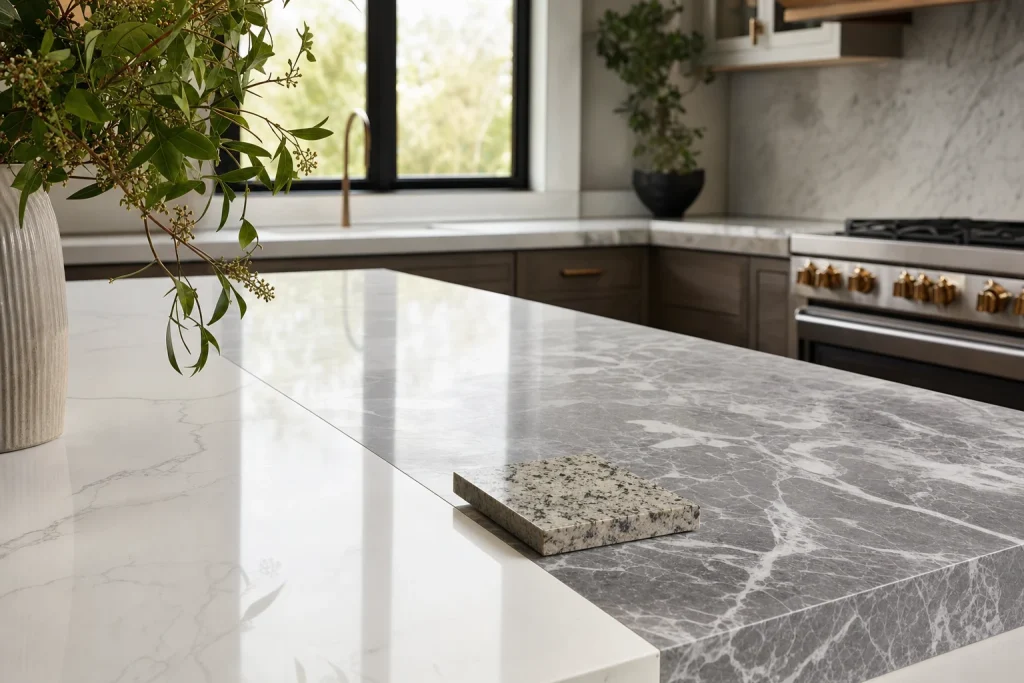
For homeowners embarking on a luxury home building or renovation project, selecting the right countertop material is a pivotal decision that impacts both aesthetics and functionality. The premier choices for high-end residences typically include quartz, marble, and granite, each offering distinct advantages in terms of…
- When undertaking luxury home remodeling and renovation, the selection of countertop materials extends beyond mere aesthetics; it involves a careful balance of durability, maintenance requirements, and how the material complements the overall design vision.
- Quartz countertops, an engineered stone product, are a top contender in luxury homes due to their exceptional blend of aesthetics and practicality.
- Selecting the ideal countertop material for your luxury home building or renovation project involves a thoughtful evaluation of several factors, moving beyond initial impressions to consider long-term performance and aesthetic integration.
- Ultra-compact surfaces like Dekton or Neolith are generally considered the most durable, offering extreme resistance to scratches, heat, UV, and stains.
The Best Countertop Materials for Luxury Homes: Quartz, Marble, Granite, and Beyond for luxury home building
For homeowners embarking on a luxury home building or renovation project, selecting the right countertop material is a pivotal decision that impacts both aesthetics and functionality. The premier choices for high-end residences typically include quartz, marble, and granite, each offering distinct advantages in terms of durability, appearance, and maintenance. Quartz, an engineered stone, is celebrated for its non-porous nature and wide range of consistent colors, making it highly resistant to stains and scratches. Marble, a natural stone, provides unparalleled elegance with its unique veining and cool touch, though it requires more diligent care due to its porosity. Granite, another natural stone, offers exceptional hardness and heat resistance, presenting a classic, robust option with diverse patterns. Beyond these, materials like quartzite, soapstone, and ultra-compact surfaces are gaining traction for their unique properties and sophisticated appeal in bespoke designs.
What Are the Primary Considerations for Countertop Selection in Luxury Home Building?
When undertaking luxury home remodeling and renovation, the selection of countertop materials extends beyond mere aesthetics; it involves a careful balance of durability, maintenance requirements, and how the material complements the overall design vision. Homeowners in Plano and the broader DFW area often prioritize longevity and ease of care, especially in high-traffic areas like kitchens. For instance, a family with young children might lean towards a highly durable and stain-resistant option like quartz, which typically requires minimal sealing and withstands daily wear effectively. Conversely, a homeowner focused on creating a timeless, elegant aesthetic might opt for marble, understanding that its natural beauty comes with a commitment to regular sealing and prompt spill cleanup. The decision also hinges on the specific room; a bathroom vanity might tolerate a more delicate material than a bustling kitchen island. Our experience with custom cabinetry solutions often highlights how the countertop choice significantly influences the functionality and visual harmony of the entire space, making it a cornerstone of the design process.
The functional demands of a space heavily influence material suitability. For example, a kitchen countertop must withstand heat, knife marks, and various food acids, whereas a decorative bar top might prioritize visual impact over extreme resilience. Consider the typical activities that will occur on the surface: will it be a primary food preparation area, a casual dining spot, or purely decorative? Materials like granite and quartzite offer superior heat resistance, making them ideal for areas near cooktops, while marble, though beautiful, can be susceptible to etching from acidic substances like lemon juice or vinegar. According to industry norms, most luxury homeowners expect their countertops to last upwards of 15-20 years with proper care, underscoring the importance of selecting a material that aligns with both lifestyle and long-term expectations. This strategic approach ensures that the chosen material not only looks stunning upon installation but also performs reliably for decades, maintaining its value and appeal within the luxury home.
Budgetary considerations, while often flexible in luxury home building, still play a role in material selection, particularly when balancing desired aesthetics with practical investments. While all luxury materials command a premium, there can be significant price variations. For instance, exotic marble slabs or highly specialized ultra-compact surfaces might fall at the higher end of the spectrum, while certain grades of granite or standard quartz options could offer a more accessible entry point into the luxury market. Beyond the initial material cost, installation complexity, edge profiling, and any necessary fabrication for unique shapes or integrated sinks also contribute to the final price. Our team at NovaStar Construction, specializing in bespoke kitchen and bathroom renovations, works closely with clients to navigate these choices, ensuring that the selected countertop material not only meets their aesthetic aspirations but also aligns with their overall project budget for a truly customized and high-value outcome.
Exploring Specific Luxury Countertop Materials
QUARTZ: THE ENGINEERED MARVEL FOR MODERN HOMES
Quartz countertops, an engineered stone product, are a top contender in luxury homes due to their exceptional blend of aesthetics and practicality. Composed of roughly 90-95% ground quartz (a natural hard mineral) and 5-10% polymer resins, pigments, and additives, quartz offers a consistent, uniform appearance that natural stones often cannot. This manufacturing process allows for a vast array of colors and patterns, including designs that mimic the look of marble or granite without their inherent vulnerabilities. Its non-porous surface is a significant advantage, making it highly resistant to staining from common kitchen culprits like coffee, wine, and oils. This characteristic also means it does not require sealing, simplifying long-term maintenance for busy homeowners.
Beyond stain resistance, quartz is remarkably durable, standing up well to scratches and impacts from daily use. It’s an ideal choice for high-traffic areas such as kitchen islands, main countertops, and even bathroom vanities where spills and wear are common. While generally heat resistant, it’s advisable to use trivets under hot pots and pans to prevent potential damage from extreme thermal shock, which can sometimes cause discoloration or cracking in the resin binders. The consistency in color and pattern across slabs also makes it easier to achieve a seamless look in larger installations, a highly valued attribute in expansive luxury kitchens where continuity is key.
MARBLE: TIMELESS ELEGANCE WITH A CLASSIC APPEAL
Marble, a metamorphic rock formed from recrystallized carbonate minerals, has been a symbol of luxury and sophistication for centuries. Its distinctive veining, which results from mineral impurities present during its formation, ensures that no two slabs are exactly alike, offering a truly unique surface for every home. The cool touch of marble is particularly appealing in kitchens for pastry making or in bathrooms for a spa-like ambiance. Popular varieties like Carrara, Calacatta, and Statuario each present different patterns and color intensities, allowing for precise aesthetic matching to a home’s interior design scheme. For instance, Calacatta marble is often chosen for its bold, dramatic veining against a bright white background, making a striking statement.
Despite its undeniable beauty, marble is a softer, more porous natural stone compared to granite or quartz. This porosity makes it susceptible to etching from acidic substances (like citrus juices, vinegar, or certain cleaning products) and staining if spills are not wiped promptly. Consequently, marble requires a higher level of care, including regular sealing—typically every 6-12 months, depending on usage and sealant quality—to protect its surface. Homeowners who select marble often do so with a full understanding of its maintenance requirements, viewing the patina that develops over time as part of its charm and history. For those prioritizing unparalleled natural beauty and willing to commit to its upkeep, marble remains an iconic choice for luxury interiors.
GRANITE: ROBUST BEAUTY AND ENDURING STRENGTH
Granite, an igneous rock formed from magma, is renowned for its exceptional hardness and durability, making it a highly practical choice for luxury countertops. Its crystalline structure provides a speckled or variegated appearance, with a vast spectrum of colors and patterns influenced by the minerals present during its formation. From deep blacks and rich browns to vibrant blues and greens, granite offers a natural aesthetic that can complement both traditional and contemporary designs. Each slab is unique, ensuring a one-of-a-kind surface that adds character and depth to any space.
One of granite’s most significant advantages is its superior resistance to heat, making it an excellent surface for kitchens where hot pots and pans are frequently used. It is also highly resistant to scratches and chips, standing up well to the rigors of daily food preparation. While naturally porous, most granite varieties are sealed during installation and require periodic re-sealing—typically annually—to maintain their stain resistance. This maintenance is straightforward and helps preserve the stone’s pristine condition for decades. For homeowners in areas like the DFW metroplex seeking a robust, long-lasting, and naturally beautiful countertop that can withstand heavy use, granite continues to be a preferred option, offering both aesthetic appeal and peace of mind.
Beyond these well-established choices, several emerging and niche materials are capturing the attention of luxury homeowners seeking truly distinctive surfaces. Quartzite, a natural stone, is often mistaken for granite due to its similar hardness and durability, but it offers a more marble-like aesthetic with subtle veining and a sophisticated sheen. Unlike marble, quartzite is significantly less porous and more resistant to etching and scratching, making it a robust option for high-traffic kitchens without the intensive maintenance demands. However, it still benefits from periodic sealing to enhance its stain resistance. Another natural stone, soapstone, presents a unique, soft, and warm feel with a distinctive matte finish that deepens in color over time, developing a rich patina. While softer than granite or quartzite, soapstone is non-porous and highly resistant to acids and heat, making it an excellent choice for those who appreciate its rustic elegance and low maintenance, as it does not require sealing but can be oiled to maintain its dark luster. Its ability to withstand extreme temperatures without damage makes it particularly suitable for areas around cooktops or fireplaces.
Ultra-compact surfaces, such as Dekton or Neolith, represent the cutting edge of engineered materials, offering unparalleled performance. These surfaces are manufactured using a sophisticated process that mimics the metamorphic changes natural stone undergoes over millennia, resulting in a material that is virtually indestructible. They are non-porous, highly resistant to UV light, extreme temperatures, scratches, and abrasions, making them suitable for both indoor and outdoor applications. Their consistent color and pattern, combined with the ability to create large, seamless installations, appeal to contemporary luxury designs that prioritize sleek lines and minimalist aesthetics. While these materials typically come at a higher price point due to their advanced manufacturing and installation complexity, their extreme durability and zero-maintenance profile offer long-term value and peace of mind for discerning homeowners. For example, a homeowner in a sunny DFW location might choose an ultra-compact surface for an outdoor kitchen, confident it will not fade or degrade under intense sunlight and heat, a common concern with other materials.
Making the Right Choice for Your Luxury Home Building Project
Selecting the ideal countertop material for your luxury home building or renovation project involves a thoughtful evaluation of several factors, moving beyond initial impressions to consider long-term performance and aesthetic integration. The decision should align with your lifestyle, the specific demands of each space, and your overall design vision. For instance, a bustling family kitchen might benefit most from the resilience and low maintenance of quartz or ultra-compact surfaces, which can withstand daily wear and tear without showing signs of age. Conversely, a formal dining room bar or a master bathroom vanity might be the perfect setting for the exquisite, unique veining of marble, where its inherent elegance can be showcased and appreciated with appropriate care. Understanding the nuances of each material—from granite’s heat resistance to soapstone’s unique patina—empowers homeowners to make informed choices that enhance both the beauty and functionality of their living spaces. Our experience with custom cabinetry solutions often begins with a discussion about countertop materials, as they are central to the entire room’s design and utility.
Consider the interplay between your chosen countertop and other design elements within your luxury home. The material’s color, pattern, and finish should complement your custom cabinetry, flooring, and wall treatments, contributing to a cohesive and harmonious aesthetic. For example, a kitchen with dark, rich wood cabinetry might be beautifully contrasted with a light-colored quartz or marble, creating visual interest and brightness. Conversely, a minimalist design featuring white cabinetry could be elevated by a dramatic granite or a bold-veined marble, making the countertop a focal point. The edge profile also plays a significant role; a sleek, mitered edge on an ultra-compact surface can reinforce a modern aesthetic, while a classic ogee edge on marble can enhance a traditional or transitional design. These details, often overlooked, are crucial in luxury home building, as they collectively define the bespoke character and refined ambiance of the space. Industry data suggests that well-integrated design elements, including countertops, can increase perceived home value by up to 10-15%.
Envisioning Your Future Living Spaces
As you consider the myriad options for your luxury home, reflect on how each countertop material will contribute to the story and functionality of your living spaces for years to come. Will it be a backdrop for daily life, a statement piece that draws the eye, or a durable workhorse that stands the test of time? The investment in high-quality countertops is an investment in the enduring beauty and utility of your home. By carefully weighing the aesthetic appeal, durability, and maintenance requirements of quartz, marble, granite, quartzite, soapstone, and ultra-compact surfaces, you can select materials that not only meet your immediate design aspirations but also enrich your lifestyle and maintain their allure for decades. This thoughtful approach ensures that every surface in your luxury home is a testament to quality, craftsmanship, and personal style.
Bottom Line: The best countertop materials for luxury home building, including quartz, marble, granite, quartzite, soapstone, and ultra-compact surfaces, offer a diverse range of aesthetics, durability, and maintenance profiles, requiring careful consideration of lifestyle, design vision, and functional demands to ensure a lasting and valuable investment.
Frequently Asked Questions
Which luxury countertop material is most durable?
Ultra-compact surfaces like Dekton or Neolith are generally considered the most durable, offering extreme resistance to scratches, heat, UV, and stains. Granite and quartz also provide excellent durability for high-traffic areas in luxury homes.
Does marble require a lot of maintenance?
Yes, marble requires more diligent care compared to other luxury materials. It is porous and susceptible to etching from acids and staining, necessitating regular sealing every 6-12 months and prompt cleanup of spills to maintain its pristine appearance.
Can quartz countertops withstand high heat?
Quartz is generally heat resistant, but it is advisable to use trivets under hot pots and pans. Extreme thermal shock can potentially damage the resin binders in quartz, leading to discoloration or cracking, so direct contact with very hot items should be avoided.
What is the main difference between granite and quartzite?
While both are natural stones, granite typically has a speckled appearance and is very hard. Quartzite offers a more marble-like aesthetic with subtle veining and is significantly less porous and more resistant to etching than marble, making it a robust alternative.