
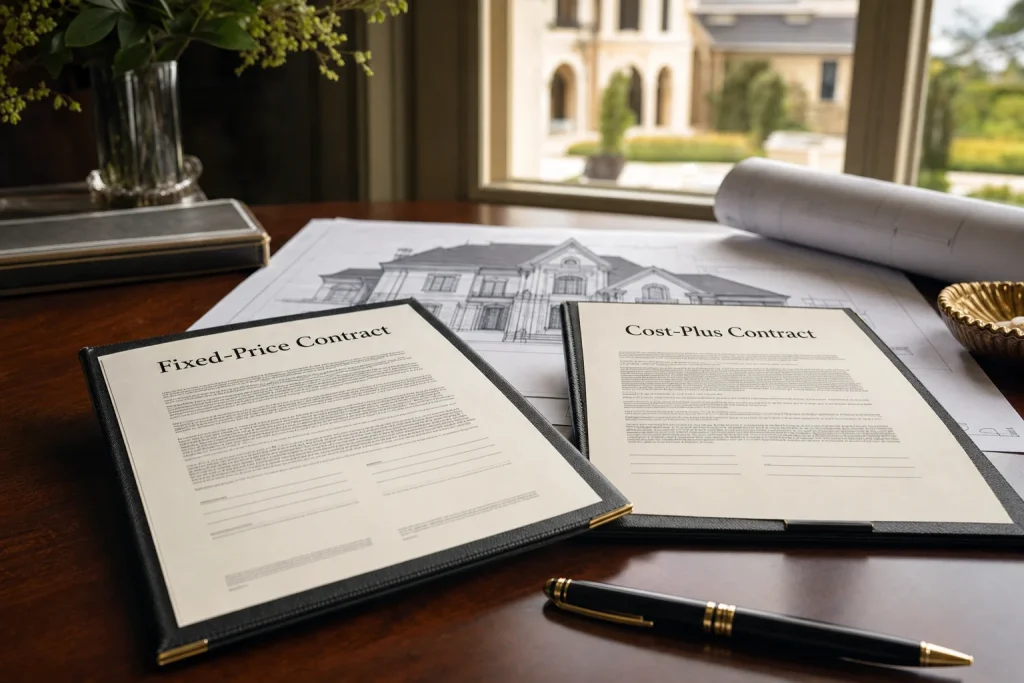
For your luxury home building project, choosing between a fixed-price and a cost-plus contract hinges on your tolerance for risk, desire for flexibility, and the project's complexity. A fixed-price contract offers budget certainty, as the total cost is agreed upon upfront, making it ideal for…
- Fixed-Price Contracts: Offer budget predictability and are best for projects with clear, unchanging scopes.
- Understanding the fundamental distinctions between fixed-price and cost-plus contracts is crucial for any homeowner embarking on a luxury home building journey.
- A fixed-price contract shines brightest when the vision for your luxury home is exceptionally clear and unlikely to change.
- Conversely, a cost-plus contract is the preferred choice for luxury home projects that embrace evolution, customization, and a high degree of personalization.
- The choice of contract also significantly influences the project timeline and the dynamic between the homeowner and builder.
Fixed-Price vs. Cost-Plus Contracts for Luxury Homes: Which is Right for Your Project?
For your luxury home building project, choosing between a fixed-price and a cost-plus contract hinges on your tolerance for risk, desire for flexibility, and the project’s complexity. A fixed-price contract offers budget certainty, as the total cost is agreed upon upfront, making it ideal for well-defined projects where changes are minimal. Conversely, a cost-plus contract provides greater transparency and flexibility, allowing for design modifications and material upgrades throughout the build, but the final cost is not determined until completion. This option is often preferred for highly customized luxury home building where unique elements and evolving preferences are anticipated, as it ensures all costs, plus an agreed-upon builder fee, are covered.
Key Insights
- Fixed-Price Contracts: Offer budget predictability and are best for projects with clear, unchanging scopes.
- Cost-Plus Contracts: Provide flexibility for design changes and material upgrades, suitable for highly customized luxury builds.
- Risk Allocation: Fixed-price shifts more risk to the builder; cost-plus shares risk with the homeowner.
- Transparency: Cost-plus offers greater insight into project expenditures, while fixed-price focuses on the final sum.
- Project Suitability: Simpler, well-defined projects favor fixed-price; complex, bespoke luxury homes often benefit from cost-plus.
What Are the Core Differences Between Fixed-Price and Cost-Plus Contracts?
Understanding the fundamental distinctions between fixed-price and cost-plus contracts is crucial for any homeowner embarking on a luxury home building journey. A fixed-price contract, also known as a lump-sum contract, means the builder agrees to complete the entire project for a single, predetermined amount. This figure encompasses all labor, materials, overhead, and profit. Once signed, this price generally remains constant unless the homeowner requests changes that necessitate a formal change order. For example, if a client in Plano, TX, decides to upgrade from standard granite countertops to a rare Brazilian quartzite after the contract is signed, this would typically incur an additional charge through a change order.
In contrast, a cost-plus contract operates on a different principle. Under this arrangement, the homeowner agrees to pay the actual cost of all materials, labor, and subcontractors, plus an agreed-upon fee for the builder’s overhead and profit. This fee can be a fixed amount, a percentage of the total costs, or a combination. For instance, a custom home builder in the DFW area might charge 15% over the documented costs for a luxury home. This structure offers unparalleled transparency, as the homeowner typically receives detailed invoices and receipts for every expense. While the final cost is not known upfront, this model allows for significant flexibility during the construction process, which is often highly valued in bespoke luxury home building projects where design evolution is common.
The choice between these two contract types significantly impacts financial predictability and project adaptability. With a fixed-price contract, the homeowner knows their maximum expenditure from the outset, assuming no scope changes. This can be reassuring for those with strict budgets. However, it can also limit spontaneity in design choices. A cost-plus contract, while offering less initial budget certainty, provides the freedom to make real-time decisions on finishes, fixtures, and even structural elements without the constant negotiation of change orders, making it a popular choice for truly custom, high-end residences where the focus is on achieving a specific vision rather than adhering to a rigid initial budget.
When to Choose a Fixed-Price Contract for Your Luxury Home
A fixed-price contract shines brightest when the vision for your luxury home is exceptionally clear and unlikely to change. This contract type is particularly well-suited for projects where the architectural plans are fully developed, material selections are finalized, and the scope of work is meticulously detailed before construction begins. Homeowners who prioritize knowing their exact financial commitment from the outset often find fixed-price agreements appealing. It provides a strong sense of security, as the builder assumes the majority of the financial risk associated with unforeseen cost increases in labor or materials, provided these are within the original scope.
Consider a scenario where a homeowner in Scottsdale, AZ, desires a Mediterranean-style villa with specific, pre-selected imported tiles, custom cabinetry designs, and a defined landscape plan. If all these elements are locked in before breaking ground, a fixed-price contract offers the advantage of a predictable budget. The builder will factor in all anticipated costs, including a contingency for minor issues, and present a single, all-inclusive price. This approach minimizes financial surprises and allows the homeowner to plan their finances with greater certainty, making it an excellent choice for those who value budget adherence above extensive mid-project modifications.
When to Opt for a Cost-Plus Contract for Your Luxury Home
Conversely, a cost-plus contract is the preferred choice for luxury home projects that embrace evolution, customization, and a high degree of personalization. This model is ideal for homeowners who anticipate making design adjustments, exploring unique materials, or incorporating cutting-edge technologies as the project progresses. The inherent flexibility of a cost-plus agreement allows for real-time decision-making without the constant need for formal change orders and their associated administrative costs and delays, which can be a significant advantage in highly bespoke builds.
Imagine a client building a contemporary smart home in Aspen, CO, where the latest advancements in home automation, energy efficiency, and sustainable materials are constantly emerging. With a cost-plus contract, this homeowner can integrate new technologies or switch to a more innovative material as it becomes available, ensuring their home is truly state-of-the-art. The transparency of this contract type means the homeowner sees every expenditure, fostering a relationship of trust and collaboration with the builder. While the final cost is not fixed upfront, the ability to achieve a truly unique and personalized residence often outweighs the desire for initial budget certainty for many luxury homeowners.
Impact on Project Timeline and Builder-Client Relationship
The choice of contract also significantly influences the project timeline and the dynamic between the homeowner and builder. A fixed-price contract, with its emphasis on a predefined scope, often leads to a more rigid timeline. Any deviation from the original plan typically requires a formal change order, which can involve negotiations, revised pricing, and potential delays as new materials are sourced or schedules adjusted. This structure can sometimes create an adversarial relationship if disagreements arise over what constitutes an “extra” versus what was included in the original scope.
In contrast, a cost-plus contract generally fosters a more collaborative and transparent relationship. Since the homeowner is directly paying for all costs plus the builder’s fee, there is a shared interest in efficient project management and cost-effective solutions. The flexibility to make changes on the fly can streamline the decision-making process, potentially avoiding delays associated with formal change order approvals. This open book approach often leads to greater trust and a smoother building experience, particularly for complex luxury projects where ongoing communication and adaptability are paramount.
The choice between these contract types also has implications for the quality control process. With a fixed-price contract, the builder has a strong incentive to complete the project within the agreed budget, which can sometimes lead to cost-cutting measures if unexpected issues arise. While reputable luxury home builders maintain high standards regardless of contract type, the fixed-price model places the onus on the homeowner to meticulously review specifications and ensure all desired quality benchmarks are explicitly stated and enforced. For example, if a specific brand of high-performance insulation was verbally discussed but not explicitly written into the fixed-price contract, the builder might opt for a less expensive, yet still code-compliant, alternative to protect their profit margin. This necessitates a proactive and detailed approach to contract negotiation and oversight from the homeowner.
Conversely, a cost-plus contract inherently aligns the builder’s and homeowner’s interests in achieving the highest quality within the project’s evolving scope. Since the homeowner is paying for all actual costs, there is less incentive for the builder to compromise on materials or craftsmanship to save money. This allows for a more collaborative approach to quality control, where both parties can openly discuss and select the best available options as the project unfolds. For instance, if a new, superior soundproofing material becomes available mid-project, a homeowner operating under a cost-plus agreement can readily approve its use, knowing they are paying the direct cost plus the builder’s agreed fee, without the need for complex change order negotiations that might occur in a fixed-price scenario. This flexibility often results in a higher overall quality and a more satisfying outcome for truly bespoke luxury residences.
Navigating Your Luxury Home Building Journey
Selecting the appropriate contract type is a foundational decision that will shape your entire luxury home building experience. It is not merely a financial choice but a strategic one that impacts flexibility, transparency, risk distribution, and the nature of your relationship with your builder. For projects with an exceptionally precise vision, where every detail from foundation to finish is meticulously planned and unlikely to deviate, a fixed-price contract offers unparalleled budget certainty. This can be particularly appealing for homeowners who have a strict financial ceiling and prefer to avoid any potential cost overruns, even at the expense of mid-project adaptability. However, this certainty comes with the requirement for exhaustive upfront planning and a robust contract that leaves no room for ambiguity.
On the other hand, if your dream luxury home involves unique architectural elements, custom-fabricated components, or a desire to incorporate the latest innovations as they emerge, a cost-plus contract provides the necessary freedom. This model is often favored by those who view their home as a dynamic canvas, where design decisions can evolve with greater insight gained during the construction process. While it requires a higher tolerance for budget fluidity, the transparency and collaborative spirit fostered by a cost-plus agreement can lead to a more personalized and ultimately more satisfying outcome, ensuring that the final residence perfectly reflects the homeowner’s evolving aspirations. Ultimately, the best contract is the one that aligns most closely with your personal preferences, risk appetite, and the specific characteristics of your luxury home building project.
Bottom Line: For luxury home building, a fixed-price contract offers budget certainty for well-defined projects, while a cost-plus contract provides flexibility and transparency for highly customized builds where design evolution is anticipated.
Frequently Asked Questions
Can a fixed-price contract include contingencies?
Yes, reputable builders often include a contingency fund within a fixed-price contract to cover minor, unforeseen issues without requiring a change order. This amount is typically a percentage of the total project cost, providing a buffer for small, unexpected expenses that do not alter the project’s overall scope.
What is the typical builder’s fee percentage in a cost-plus contract?
The builder’s fee in a cost-plus contract can vary significantly, typically ranging from 10% to 25% of the total project costs. This percentage depends on factors such as the builder’s experience, the complexity of the luxury home project, and the local market conditions.
Which contract type offers more protection for the homeowner?
Both contract types offer protection, but in different ways. A fixed-price contract protects the homeowner from cost overruns on the builder’s side, assuming no scope changes. A cost-plus contract protects the homeowner through transparency, allowing them to see and approve every expenditure, ensuring fair pricing for materials and labor.