
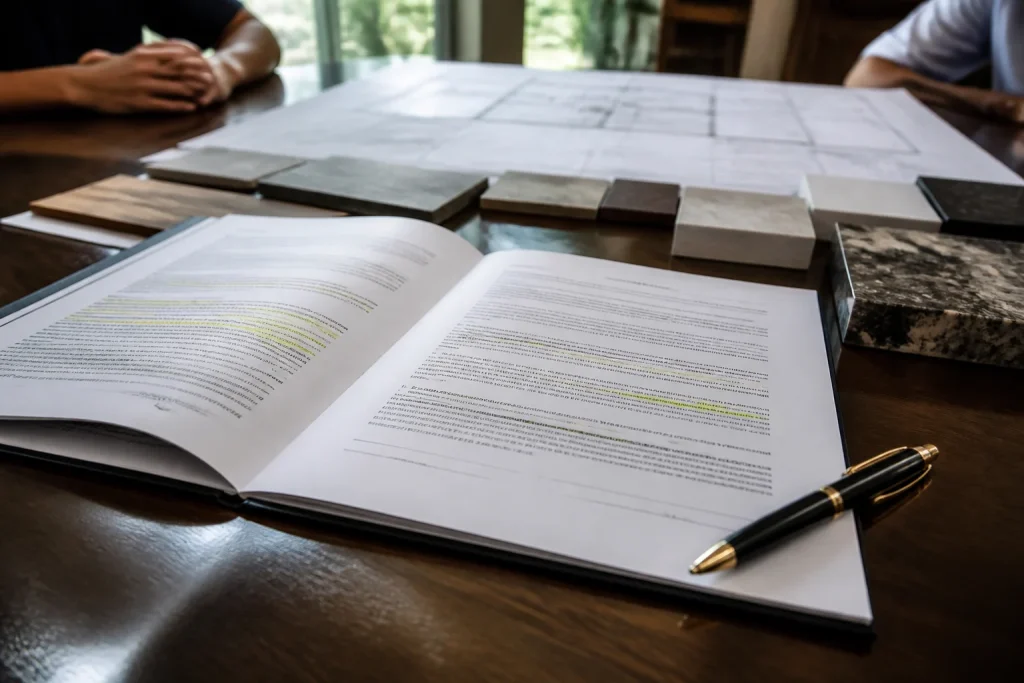
Navigating luxury home building contracts requires meticulous attention to detail to safeguard your investment and ensure your vision is realized. A robust contract should clearly define the scope of work, payment schedules, change order procedures, and a comprehensive dispute resolution mechanism.
- Detailed Specifications are Non-Negotiable: Ensure every material, finish, and fixture is explicitly named, not just generally described.
- When embarking on a luxury home building project, the contract serves as the foundational document governing every aspect of the construction.
- Beyond the contractual specifics, actively engaging in the project and understanding your role as the homeowner is paramount to a successful luxury home building experience.
- Detailed material specifications prevent builders from substituting lower-quality items, ensuring your luxury home meets your exact aesthetic and performance expectations.
Luxury Home Building Contracts: What to Look For to Protect Your Interests
Navigating luxury home building contracts requires meticulous attention to detail to safeguard your investment and ensure your vision is realized. A robust contract should clearly define the scope of work, payment schedules, change order procedures, and a comprehensive dispute resolution mechanism. Key elements to scrutinize include detailed specifications for materials and finishes, a firm timeline with penalty clauses for delays, and explicit warranties covering craftsmanship and structural integrity. For instance, a contract for a custom home in Plano, TX, should specify the exact brand and model of appliances, the type of natural stone for countertops, and the specific grade of lumber, rather than generic terms. Without these precise details, homeowners risk significant cost overruns, quality compromises, and prolonged construction periods, often leading to disputes over expectations versus deliverables. According to industry surveys from 2023, poorly defined contracts are a leading cause of project delays and budget overruns in high-end residential construction.
Key Insights
- Detailed Specifications are Non-Negotiable: Ensure every material, finish, and fixture is explicitly named, not just generally described.
- Clear Payment Milestones: Link payments to verifiable stages of completion, not just calendar dates, to maintain leverage.
- Robust Change Order Process: Establish a formal, written procedure for any modifications, including cost and schedule impacts, before work proceeds.
- Comprehensive Warranty and Dispute Resolution: Demand clear warranties for structural elements and craftsmanship, alongside a defined process for addressing disagreements.
- Understand Delay and Liquidated Damages: Look for clauses that protect you from project delays, potentially including financial penalties for the builder.
What Specific Clauses Should You Prioritize in a Luxury Home Building Contract?
When embarking on a luxury home building project, the contract serves as the foundational document governing every aspect of the construction. Prioritizing specific clauses is crucial for protecting your interests. Beyond the obvious scope of work, pay close attention to the “Allowances” section. Allowances are budget line items for items not yet selected, such as lighting fixtures or landscaping. A common pitfall is vague allowance amounts that inevitably lead to upgrades and significant out-of-pocket expenses. For example, if an allowance for kitchen cabinetry is set at $25,000, but your chosen custom European-style cabinets cost $75,000, you are responsible for the $50,000 difference. A well-structured contract will either minimize allowances by requiring early selections or provide realistic, higher-end estimates for these items, reflecting the true cost of luxury finishes. Industry best practices, as of 2024, suggest that allowances should represent no more than 10-15% of the total project cost in a truly bespoke luxury build.
Another critical area is the “Schedule and Delays” clause. Luxury home construction often involves complex logistics and specialized trades, making adherence to timelines paramount. A strong contract will outline a detailed project schedule with specific milestones and completion dates. Crucially, it should include provisions for “liquidated damages,” which are pre-agreed financial penalties the builder pays for each day the project runs past the agreed-upon completion date, provided the delay is not due to client-requested changes or unforeseen circumstances like severe weather. For instance, a contract might stipulate a $500 per day penalty for unexcused delays beyond the agreed-upon move-in date. This clause incentivizes the builder to stay on track and provides you with a measure of compensation for additional living expenses or inconvenience. Without such a clause, proving actual damages from delays can be a lengthy and expensive legal process, often leaving homeowners without recourse.
Furthermore, the “Change Order Procedure” is vital. In luxury home building, modifications are almost inevitable as the project progresses and your vision evolves. A robust contract will detail a formal, written process for all change orders. This typically requires a written request from either party, a detailed description of the change, an itemized cost breakdown, and an assessment of its impact on the project schedule. Both parties must sign off on the change order before any work related to it commences. This prevents verbal agreements from leading to disputes over costs or scope. Imagine you decide to upgrade from standard hardwood flooring to a rare, imported Brazilian cherry wood after construction has begun. A proper change order would clearly state the additional material cost, labor adjustments, and any impact on the project timeline, ensuring transparency and mutual agreement before the change is implemented. This structured approach, according to consumer-protection guidance, minimizes misunderstandings and protects both parties from unexpected financial burdens.
Understanding Indemnification and Insurance Requirements
Beyond the direct construction clauses, a robust luxury home contract must clearly delineate indemnification and insurance requirements. Indemnification clauses protect you from liabilities arising from the builder’s negligence or actions during construction. This means the builder agrees to compensate you for any losses or damages incurred due to their work. For example, if a subcontractor causes damage to an adjacent property, the indemnification clause ensures the builder, not you, is responsible for covering the repair costs and any legal fees. It’s crucial that this clause is broad enough to cover all potential third-party claims and liabilities that might arise from the construction process. Without adequate indemnification, you could find yourself entangled in costly legal battles for issues entirely outside your control.
Complementing indemnification, the contract should mandate specific insurance coverage from the builder. This typically includes comprehensive general liability insurance, workers’ compensation insurance, and builder’s risk insurance. General liability protects against property damage or bodily injury to third parties during construction. Workers’ compensation covers injuries sustained by the builder’s employees on your property, preventing you from being held liable. Builder’s risk insurance, often overlooked, covers the structure itself and materials on site from perils like fire, theft, or vandalism during the construction phase. A contract for a high-value property, such as a multi-million dollar estate in Aspen, CO, should specify minimum coverage amounts that adequately reflect the project’s scale and potential risks, often requiring limits of several million dollars. Always request certificates of insurance directly from the builder’s insurance providers to verify active and sufficient coverage before construction commences.
Defining Subcontractor Management and Lien Waivers
The management of subcontractors is another pivotal aspect of luxury home building that warrants explicit contractual language. Most custom home builders rely on a network of specialized subcontractors for various trades, from intricate masonry to advanced smart home system installations. The contract should clearly state the builder’s responsibility for vetting, supervising, and managing all subcontractors. This includes ensuring they are properly licensed, insured, and adhere to the project’s quality standards and schedule. A common issue arises when a subcontractor is not paid by the general contractor and subsequently places a mechanic’s lien on your property, effectively holding your home hostage until their payment dispute is resolved. This can happen even if you have paid your general contractor in full.
To mitigate the risk of mechanic’s liens, the contract should require the builder to provide lien waivers from all major subcontractors and suppliers with each payment installment. A lien waiver is a document signed by a subcontractor or supplier relinquishing their right to place a lien on your property for the amount they have been paid. There are typically two types: partial waivers, submitted with progress payments, and final waivers, submitted upon completion of their work. For instance, after the framing is complete and the builder requests payment for that phase, you should receive partial lien waivers from the framing crew and lumber supplier. A comprehensive contract will stipulate that final payment to the builder is contingent upon receiving final lien waivers from all parties involved in the project, ensuring your property remains free and clear of encumbrances. This proactive measure is a critical safeguard for your financial interests.
Finally, the “Termination Clause” is a critical, albeit often overlooked, component. While no one enters a luxury home building project expecting it to fail, circumstances can arise where ending the contract prematurely becomes necessary. A well-drafted termination clause will outline the conditions under which either party can terminate the agreement, the required notice period, and the financial implications of such an action. For instance, it should specify what happens to payments already made, how work in progress is valued, and who is responsible for demobilization costs. If the builder defaults on key contractual obligations, such as repeated delays or significant quality issues, the clause should empower you to terminate the contract without penalty and potentially recover damages. Conversely, if you decide to terminate for convenience, the clause should detail the builder’s entitlement to compensation for work completed and reasonable overhead. According to legal experts specializing in construction law, clear termination clauses can save homeowners hundreds of thousands of dollars in litigation costs by providing a predefined roadmap for disengagement, rather than leaving it to contentious negotiation. This foresight ensures that even in the worst-case scenario, your interests are protected and the path forward is clearly defined.
Securing Your Vision: Proactive Steps for a Flawless Luxury Home Building Journey
Beyond the contractual specifics, actively engaging in the project and understanding your role as the homeowner is paramount to a successful luxury home building experience. Regular site visits, though often managed by the builder, should be part of your routine. These visits allow you to observe progress firsthand, ask questions, and address minor concerns before they escalate. It’s advisable to schedule formal walkthroughs at key milestones, such as after framing, rough-ins (electrical, plumbing, HVAC), and before drywall installation. During these walkthroughs, bring a copy of your detailed specifications and blueprints to verify that the work aligns with the agreed-upon plans. For example, confirming the exact placement of electrical outlets or the type of insulation being installed during the rough-in phase can prevent costly rework later. Industry professionals often recommend engaging an independent third-party inspector at critical junctures, even if the builder has their own quality control. This independent oversight, particularly for structural elements and complex systems, provides an additional layer of assurance and can identify potential issues that might be missed, protecting your long-term investment. A 2023 survey of high-net-worth individuals found that those who engaged independent inspectors reported significantly higher satisfaction with their custom home builds.
Effective communication is the bedrock of any successful construction project, especially in the nuanced world of luxury homes. Establish a clear communication protocol with your builder from the outset. This should include designated points of contact, preferred methods of communication (e.g., email for formal requests, phone for urgent matters), and expected response times. Avoid making critical decisions or changes through casual conversations; always follow up verbal discussions with written confirmation to create a clear record. For instance, if you discuss a change to the master bathroom tile during a site visit, send an email summarizing the discussion and requesting a formal change order. This practice minimizes misunderstandings and provides a paper trail should any disputes arise. Many luxury builders now utilize project management software that allows homeowners to track progress, view schedules, and approve documents digitally, enhancing transparency and streamlining communication. As one veteran luxury home builder puts it, “The best contracts are those that are rarely referenced because communication was so clear from day one.” This proactive approach to interaction fosters a collaborative environment, ensuring that your evolving vision is accurately translated into the final product without friction.
Finally, understanding the post-completion phase and warranty activation is crucial. Your contract should clearly outline the builder’s responsibilities after the certificate of occupancy is issued. This typically includes a final walkthrough to create a “punch list” of minor items needing correction or completion before final payment. Be thorough during this walkthrough, testing all appliances, checking every light fixture, and inspecting all surfaces for imperfections. The contract should also detail the warranty period for various components of your home—typically one year for general craftsmanship, two years for systems (plumbing, electrical, HVAC), and ten years for major structural defects. Ensure you receive all manufacturer warranties for appliances, fixtures, and materials, as these often extend beyond the builder’s warranty. For example, a high-end refrigerator might come with a five-year manufacturer’s warranty, which you would manage directly with the appliance company after the builder’s initial warranty period expires. Knowing these timelines and processes ensures you can address any issues that arise post-move-in efficiently and effectively, maintaining the pristine condition and value of your luxury home for years to come. This comprehensive approach, from initial contract review to post-occupancy support, solidifies the protection of your significant investment.
Ensuring Your Legacy: What Comes After the Build?
After the keys are handed over and you’ve settled into your magnificent new residence, the contractual relationship with your builder doesn’t simply vanish. The post-construction phase is equally important for safeguarding your investment and ensuring long-term satisfaction. Your contract should detail the builder’s commitment to addressing warranty claims and providing ongoing support. This often includes a specific process for submitting warranty requests, outlining response times, and defining the scope of covered repairs. For example, if a custom-built cabinet door warps within the first year, the contract should specify how to report it and the timeframe within which the builder will rectify the issue. Many luxury builders offer a dedicated client service team for warranty support, recognizing that even the finest homes may require minor adjustments as they settle. It’s also wise to maintain a comprehensive file of all contract documents, change orders, and warranty information for future reference. This organized approach, recommended by consumer advocacy groups, simplifies any potential claims and ensures you have all necessary documentation at your fingertips. Ultimately, a well-structured contract extends its protective umbrella far beyond the construction period, providing peace of mind for the lifetime of your luxury home.
Bottom Line: A meticulously crafted luxury home building contract is your primary defense against unforeseen costs, delays, and quality issues, requiring precise details on materials, payment, change orders, and robust protection clauses for indemnification and lien waivers.
Frequently Asked Questions
Why are detailed material specifications so important?
Detailed material specifications prevent builders from substituting lower-quality items, ensuring your luxury home meets your exact aesthetic and performance expectations. Generic terms can lead to significant cost overruns and quality compromises, as the builder might choose cheaper alternatives.
What are liquidated damages in a construction contract?
Liquidated damages are pre-agreed financial penalties the builder pays for each day the project runs past the scheduled completion date due to unexcused delays. This clause incentivizes timely completion and compensates the homeowner for inconvenience or additional expenses.
How do lien waivers protect a homeowner?
Lien waivers are documents signed by subcontractors and suppliers, relinquishing their right to place a mechanic’s lien on your property for the amount they’ve been paid. This prevents you from being held responsible if your general contractor fails to pay their vendors.
What insurance should a luxury home builder carry?
A luxury home builder should carry comprehensive general liability, workers’ compensation, and builder’s risk insurance. These policies protect against property damage, worker injuries, and damage to the structure during construction, safeguarding your investment and preventing personal liability.