
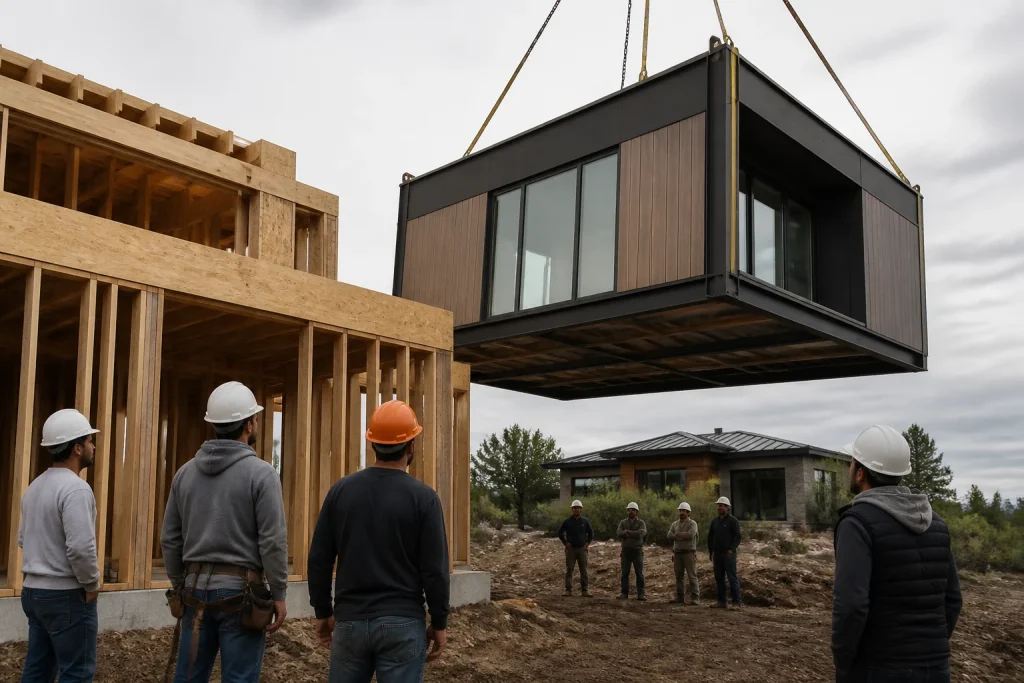
When considering luxury home building, the choice between prefabricated and site-built construction methods hinges primarily on a trade-off between speed and customization. Prefabricated luxury homes, often constructed in controlled factory environments, offer significantly faster completion times—typically 30-50% quicker than traditional site-built homes—due to parallel processing…
- The fundamental distinctions between prefabricated and site-built luxury homes extend beyond mere construction location, impacting everything from material sourcing to long-term value.
- The choice between prefabricated and site-built luxury homes also carries significant implications for material quality and sustainability.
- The long-term value and resale potential of a luxury home can be influenced by its construction method, though market perception often plays a significant role.
- Choosing the right construction method for your luxury home building project requires careful consideration of several factors beyond just speed and customization.
- No, prefabricated luxury homes are distinct from mobile homes.
Prefabricated vs. Site-Built Luxury Homes: Weighing Speed Against Customization
When considering luxury home building, the choice between prefabricated and site-built construction methods hinges primarily on a trade-off between speed and customization. Prefabricated luxury homes, often constructed in controlled factory environments, offer significantly faster completion times—typically 30-50% quicker than traditional site-built homes—due to parallel processing of foundation work and module fabrication, reducing weather delays and labor inefficiencies. However, this efficiency often comes with inherent limitations on design flexibility and the extent of bespoke architectural details. Site-built homes, conversely, provide unparalleled customization, allowing for unique architectural expressions, complex layouts, and on-the-fly design adjustments, albeit with longer construction timelines, usually ranging from 12 to 24 months for high-end projects, and a greater susceptibility to environmental factors and on-site labor challenges. For homeowners prioritizing a swift move-in and predictable schedule, prefabricated options present a compelling case, while those seeking a truly one-of-a-kind residence with intricate design elements will find site-built methods more accommodating.
What are the Core Differences in Luxury Home Building Approaches?
The fundamental distinctions between prefabricated and site-built luxury homes extend beyond mere construction location, impacting everything from material sourcing to long-term value. Site-built construction, often referred to as “stick-built,” involves assembling a home piece by piece directly on its permanent foundation. This traditional method allows for virtually limitless architectural freedom, enabling complex cantilevers, unique ceiling heights, and custom material integrations like hand-laid stone or bespoke millwork. Architects and designers have the flexibility to adapt plans during the build, responding to site-specific challenges or evolving client preferences. For instance, a client might decide to expand a master bathroom or reconfigure a kitchen island during the framing stage, a level of adaptability that is difficult to achieve with prefabricated modules. This bespoke approach, while time-consuming, ensures that each element of the home is tailored precisely to the homeowner’s vision and the unique characteristics of the property, often resulting in a residence that feels deeply integrated with its surroundings.
In contrast, prefabricated luxury homes, encompassing modular, panelized, and even some forms of manufactured housing, involve constructing significant portions of the home off-site in a factory. Modular homes, for example, are built as three-dimensional sections (modules) that are then transported and assembled on the foundation. Panelized homes use pre-cut wall, floor, and roof panels. This factory-controlled environment offers several advantages, including consistent quality due to stringent oversight, reduced material waste, and protection from weather-related damage during the initial construction phases. A key benefit is the accelerated timeline; while a site-built luxury home might take 18 months to complete, a comparable modular home could be ready for occupancy in 6-9 months, including site preparation and finishing work. This speed is particularly appealing in markets where construction labor is scarce or where homeowners need to relocate quickly. However, the modular nature imposes certain design constraints, such as limitations on module size for transport and the need for standardized connections, which can sometimes restrict the grander, more open-concept designs often desired in high-end properties. For example, a sprawling, multi-story atrium might be more challenging to achieve with pre-fabricated modules than with traditional on-site framing.
The choice between these methods also influences the project management and financial aspects of luxury home building. Site-built projects typically involve a general contractor who manages a diverse team of subcontractors, coordinating schedules, materials, and inspections on an ongoing basis. This can lead to more complex project management and potential cost overruns if not meticulously managed. According to a 2023 industry report, unexpected site conditions and labor shortages were among the top reasons for project delays and budget increases in traditional construction. Prefabricated homes, while still requiring site preparation and finishing, centralize much of the construction process with the factory, often leading to more predictable costs and timelines. The initial design and engineering phases are critical and must be finalized before factory production begins, leaving less room for changes once manufacturing is underway. This upfront planning can be an advantage for homeowners who have a clear vision and prefer a streamlined process, but it can be a drawback for those who anticipate wanting to make significant modifications as the project progresses.
Material Quality and Sustainability Considerations
The choice between prefabricated and site-built luxury homes also carries significant implications for material quality and sustainability. Site-built construction traditionally offers an expansive palette of materials, from locally sourced hardwoods and natural stones to custom-fabricated metals and artisanal finishes. This allows for a high degree of material specificity, enabling builders to select components based on their aesthetic appeal, durability, and even their embodied energy or regional availability. For instance, a homeowner might specify reclaimed timber from a historic barn for structural beams or opt for regionally quarried granite countertops, enhancing both the home’s character and its environmental footprint through reduced transportation. However, traditional site construction can also generate substantial on-site waste, with estimates suggesting that construction and demolition debris account for a significant portion of landfill waste annually.
Prefabricated luxury homes, conversely, often excel in waste reduction and material efficiency due to their factory-controlled production environment. Factories can implement precise cutting techniques and recycling programs, minimizing scrap material. Furthermore, the controlled setting protects materials from weather exposure, preventing damage and spoilage that can occur on an open construction site. While the range of materials might be somewhat standardized to optimize factory processes, many high-end prefabricated manufacturers now offer an impressive selection of premium finishes, energy-efficient windows, and sustainable building envelopes. For example, a modular home might come standard with high-performance insulation and airtight construction, contributing to superior energy efficiency from day one. The challenge lies in ensuring that these standardized options meet the specific luxury aesthetic and performance expectations of a discerning client, though customization options are continually expanding within the prefabricated sector.
Long-Term Value and Resale Potential
The long-term value and resale potential of a luxury home can be influenced by its construction method, though market perception often plays a significant role. Site-built luxury homes, particularly those with unique architectural designs, bespoke features, and high-quality, enduring materials, tend to hold strong resale value. Their perceived uniqueness and the ability to integrate seamlessly with specific landscapes often appeal to buyers seeking an exclusive property. A custom-built estate designed by a renowned architect, for example, often commands a premium due to its singular nature and the craftsmanship involved. Buyers often associate traditional construction with superior quality and durability, even if modern prefabricated methods can achieve comparable or better structural integrity.
Prefabricated luxury homes, while offering many advantages in construction, have historically faced a perception challenge in the resale market, though this is rapidly changing. Early manufactured homes sometimes suffered from lower quality stereotypes, which unfairly impacted the perception of high-end modular and panelized homes. However, as the quality, design sophistication, and energy efficiency of prefabricated luxury homes have dramatically improved, so too has their market acceptance. A well-designed, high-quality prefabricated luxury home built to stringent standards can offer excellent long-term value, especially if it incorporates desirable features like smart home technology, advanced energy systems, and premium finishes. The key for resale often lies in the quality of the factory, the reputation of the builder, and the overall aesthetic appeal and integration with the site, rather than merely the method of construction itself. As an example, a luxury modular home built in a desirable location with custom interior finishes and a thoughtful landscape plan can compete effectively with site-built homes in the same market segment.
The decision between a prefabricated and a site-built luxury home ultimately boils down to a homeowner’s priorities, lifestyle, and tolerance for various project dynamics. For those who value predictability, efficiency, and a faster path to occupancy, modern prefabricated methods offer a compelling solution without sacrificing quality or aesthetic appeal. These homes are increasingly incorporating advanced smart home technologies, sustainable materials, and customizable interior finishes that rival their site-built counterparts. For example, a family needing to relocate for a new job might find the 6-9 month timeline of a high-end modular home far more appealing than the 18-24 months required for a traditional build, especially if they have specific school enrollment deadlines or lease expirations to consider. The upfront planning required for prefabricated homes can also be a benefit, as it forces detailed decision-making early in the process, potentially reducing stress and changes during construction.
Conversely, for individuals whose vision demands absolute creative freedom, intricate architectural details, and the flexibility to make design adjustments throughout the construction process, a site-built luxury home remains the preferred choice. This method allows for truly unique expressions of personal style, accommodating challenging lot conditions, and integrating bespoke elements that are difficult to replicate in a factory setting. Consider a homeowner with a complex, irregularly shaped lot overlooking a scenic vista; a site-built home could be meticulously designed to maximize every angle and view, incorporating custom terraces, multi-level living spaces, and unique window placements that would be impractical for modular transport. While the longer timeline and potential for unforeseen challenges are factors, the end result is a residence that is uniquely tailored to its owner and environment, often becoming a legacy property. The ability to personally oversee every detail and interact directly with artisans and craftsmen on-site also appeals to many luxury buyers.
Making an Informed Choice for Your Luxury Home Building Project
Choosing the right construction method for your luxury home building project requires careful consideration of several factors beyond just speed and customization. It involves evaluating your budget flexibility, desired level of involvement, and long-term goals for the property. For instance, while prefabricated homes often boast more predictable costs due to factory efficiencies, the initial investment in design and engineering can be substantial, and site preparation costs (foundations, utilities, landscaping) are still significant. A 2023 analysis by the National Association of Home Builders indicated that site preparation and foundation work can account for 15-20% of the total project cost, regardless of the superstructure method. Homeowners should also consider the availability of qualified builders for each method in their desired location. Some regions have a more robust infrastructure for traditional site-built construction, while others are seeing a rise in specialized prefabricated home installers.
Another crucial aspect is the environmental impact and energy performance of the finished home. While both methods can achieve high levels of sustainability, their approaches differ. Prefabricated homes often have an inherent advantage in energy efficiency due to tighter construction tolerances and reduced thermal bridging achieved in a controlled factory environment. This can lead to lower utility bills and a smaller carbon footprint over the home’s lifespan. For example, a modular home might achieve Passive House standards more readily than a comparable site-built home, thanks to precision-engineered wall panels and factory-installed insulation. Site-built homes, however, offer greater flexibility in incorporating specific green technologies, such as extensive solar panel arrays, geothermal heating systems, or rainwater harvesting, which can be integrated more organically into a custom design. The choice should align with your personal commitment to environmental stewardship and desired operational efficiency.
Your Next Steps in Luxury Home Building
To make the best decision for your luxury home building journey, begin by clearly defining your priorities. Create a detailed list of non-negotiable design elements, desired completion timelines, and budget parameters. Research reputable builders and manufacturers specializing in both prefabricated and site-built luxury homes in your target area. Engage with architects and designers early in the process to explore how your vision can be realized through each construction method. Request detailed proposals that outline timelines, material specifications, and cost breakdowns for both options. Visiting completed projects or factory tours can provide invaluable insights into the quality and aesthetic possibilities of each approach. This comprehensive due diligence will empower you to choose the method that best aligns with your unique aspirations for a truly exceptional luxury residence.
Bottom Line: The choice between prefabricated and site-built luxury homes hinges on balancing a desire for speed and cost predictability with the need for ultimate design customization and on-site flexibility. Both methods can deliver high-quality, luxurious residences, but they cater to different priorities in the home-building journey.
Frequently Asked Questions
Are prefabricated luxury homes considered “mobile homes”?
No, prefabricated luxury homes are distinct from mobile homes. They are built to the same or higher building codes as site-built homes, permanently affixed to a foundation, and designed for high-end aesthetics and durability, unlike recreational vehicles or manufactured homes of lower quality.
Can I customize a prefabricated luxury home?
Yes, modern prefabricated luxury homes offer significant customization options, including floor plans, finishes, fixtures, and smart home technology. While there might be some structural limitations due to module transport, high-end manufacturers provide extensive choices to personalize your residence.
Do site-built luxury homes always cost more than prefabricated ones?
Not necessarily. While site-built homes often have higher labor costs and potential for overruns, a highly customized prefabricated luxury home with premium finishes and complex site preparation can be comparable in price. The total cost depends heavily on design complexity, materials, and location.