
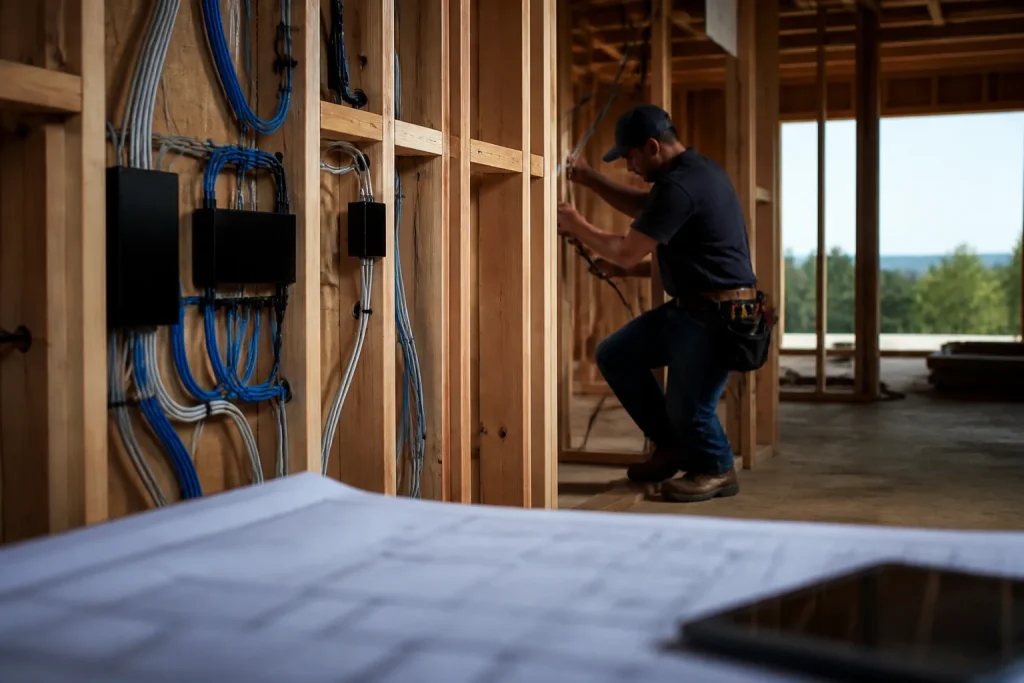
Integrating smart home technology during the initial construction phase of a luxury home building project is crucial for avoiding expensive and disruptive retrofits later. By planning and installing infrastructure for systems like automated lighting, climate control, security, and entertainment from the ground up, homeowners can…
- The foundation of any truly integrated smart home experience lies in its underlying infrastructure, which is best established during the initial construction of a new residence.
- Early integration avoids the high labor and material costs associated with retrofitting, which can add 20-30% to installation expenses.
- Integrating smart home technology during the initial construction phase of a luxury home building project is crucial for avoiding expensive and disruptive retrofits later.
- By planning and installing infrastructure for systems like automated lighting, climate control, security, and entertainment from the ground up, homeowners can achieve seamless functionality, enhanced aesthetics, and significant cost savings.
- This proactive approach ensures that wiring, power, and network connectivity are precisely placed within walls and ceilings, optimizing performance and preventing the need to open up finished surfaces, which can add 20-30% to installation costs…
Smart Home Integration During Construction: Avoiding Costly Retrofits Later for Luxury Home Building
Integrating smart home technology during the initial construction phase of a luxury home building project is crucial for avoiding expensive and disruptive retrofits later. By planning and installing infrastructure for systems like automated lighting, climate control, security, and entertainment from the ground up, homeowners can achieve seamless functionality, enhanced aesthetics, and significant cost savings. This proactive approach ensures that wiring, power, and network connectivity are precisely placed within walls and ceilings, optimizing performance and preventing the need to open up finished surfaces, which can add 20-30% to installation costs compared to pre-construction integration, according to industry estimates from 2024. Early integration also allows for a more cohesive design, where technology complements the home’s architecture rather than appearing as an afterthought.
Why is Early Smart Home Planning Essential for New Construction?
The foundation of any truly integrated smart home experience lies in its underlying infrastructure, which is best established during the initial construction of a new residence. Attempting to add sophisticated smart systems after walls are closed and finishes are applied often leads to compromises in performance, aesthetics, and budget. For instance, installing multi-room audio or advanced network cabling in an existing home typically requires extensive drywall removal, patching, and repainting, significantly increasing labor and material costs. A study by the Consumer Technology Association (CTA) in 2023 indicated that homes with integrated smart technology from the outset command a higher market value, often seeing an appreciation of 5-7% compared to similar properties without such foresight. This early planning allows for dedicated conduits, structured wiring panels, and strategically placed power outlets, ensuring that future technological upgrades are straightforward and less invasive.
Beyond cost implications, early planning ensures that the smart home system is robust and reliable. Wireless solutions, while convenient, can suffer from interference, dead zones, and bandwidth limitations, especially in larger luxury homes with extensive square footage and multiple levels. Hardwired connections, planned during construction, provide superior speed, stability, and security for critical systems like high-definition video surveillance, enterprise-grade Wi-Fi networks, and whole-home automation controllers. Consider a scenario where a homeowner desires a fully automated lighting system with tunable white light and color-changing capabilities across 50 fixtures. Retrofitting such a system would involve running new low-voltage wiring to each fixture, installing specialized dimmers, and integrating a central control hub, a process that could easily add tens of thousands of dollars and weeks of disruption. By contrast, pre-wiring during construction allows for efficient installation of these components, often at a fraction of the post-construction cost and without any aesthetic compromise.
Furthermore, integrating smart home technology from the blueprint stage facilitates a more cohesive and intuitive user experience. Architects, builders, and technology integrators can collaborate to design systems that are not only functional but also blend seamlessly with the home’s interior design. This might involve concealing speakers within walls or ceilings, flush-mounting touch panels, or integrating motorized shades directly into window frames. For example, a high-end media room designed during construction can incorporate acoustically transparent screens, hidden projectors, and integrated surround sound, creating an immersive experience that would be nearly impossible to achieve without extensive modifications in a finished space. This level of integration ensures that the technology enhances the living environment without becoming an obtrusive element, a key differentiator in the luxury home building market.
Key Considerations for Pre-Construction Smart Home Planning
Successful smart home integration begins with a comprehensive strategy developed early in the design phase. This involves more than just selecting devices; it requires a deep understanding of the homeowner’s lifestyle, future needs, and the specific architectural characteristics of the luxury property. A crucial first step is defining the scope of automation: what systems will be integrated (e.g., lighting, HVAC, security, entertainment, window treatments), and to what degree? For instance, a homeowner might desire simple remote control for lighting, or a sophisticated system that automatically adjusts based on occupancy, time of day, and natural light levels. Clearly outlining these expectations upfront allows the design team to specify appropriate technologies and allocate the necessary infrastructure.
Another vital consideration is scalability and future-proofing. Technology evolves rapidly, and a well-planned smart home should be able to accommodate upgrades and new innovations without requiring major overhauls. This often translates to installing extra conduits, larger structured wiring panels, and more network drops than immediately necessary. For example, while a homeowner might initially only want basic Wi-Fi, pre-installing Cat6a or even fiber optic cabling to key locations ensures the home is ready for future high-bandwidth applications like 8K video streaming, virtual reality, or advanced home office setups. This foresight protects the investment and prevents the home from becoming technologically obsolete prematurely.
The Role of Collaboration in Smart Home Integration
Effective smart home integration in luxury construction is inherently a collaborative process, requiring seamless communication between various stakeholders. The architect plays a pivotal role in designing spaces that can accommodate technology discreetly and efficiently, ensuring that aesthetic integrity is maintained. The builder is responsible for executing the physical installation of infrastructure, adhering to precise specifications for wiring runs, equipment placement, and power requirements. Crucially, a dedicated smart home technology integrator acts as the central expert, translating the homeowner’s vision into a functional system, advising on product selection, and overseeing the technical implementation.
This collaborative approach ensures that potential conflicts are identified and resolved early. For example, the placement of an in-ceiling speaker might conflict with a structural beam or an HVAC duct. By involving the technology integrator from the blueprint stage, such issues can be addressed on paper, preventing costly on-site modifications. Regular meetings and shared documentation among the architect, builder, interior designer, and technology integrator are essential to synchronize efforts and ensure that all aspects, from electrical layouts to network topology, are harmonized. This integrated design process leads to a more refined outcome, where technology is not merely added but is an intrinsic part of the home’s design and functionality.
This integrated design process leads to a more refined outcome, where technology is not merely added but is an intrinsic part of the home’s design and functionality.
Ensuring Long-Term Value and Adaptability in Luxury Home Building
Beyond the immediate benefits of seamless integration and cost savings, early smart home planning significantly contributes to the long-term value and adaptability of a luxury home. A property equipped with a robust, pre-installed technological backbone is inherently more attractive to future buyers, as it eliminates the need for them to undertake disruptive and expensive upgrades. According to a 2024 report by the National Association of Home Builders (NAHB), smart home features are among the top amenities desired by luxury homebuyers, with integrated security and energy management systems leading the demand. This foresight in construction ensures that the home remains competitive in the high-end real estate market for years to come. Furthermore, a well-designed infrastructure allows for easy updates to individual components as technology advances, without requiring a complete overhaul of the system. For instance, upgrading from a 1080p video distribution system to 4K or 8K simply involves swapping out endpoints and central processors, rather than re-cabling the entire home, a process that could otherwise cost upwards of $15,000 for a large residence.
The adaptability of a pre-wired smart home also extends to evolving lifestyle needs. A family’s requirements for entertainment, security, or home office capabilities can change dramatically over time. A home initially designed with ample network ports, power outlets in strategic locations, and flexible conduit pathways can easily accommodate new devices or reconfigure spaces without invasive construction. Consider a scenario where a homeowner decides to convert a guest bedroom into a dedicated home theater or a high-performance gaming room. If the room was pre-wired with multiple Cat6a drops, dedicated power circuits, and perhaps even speaker pre-wiring during the initial build, the conversion becomes a straightforward installation task. Without this foresight, the project would involve opening walls, running new electrical and data lines, and patching drywall, potentially adding weeks to the timeline and thousands of dollars to the budget. This flexibility is a hallmark of true luxury, providing peace of mind and preserving the home’s aesthetic integrity.
Moreover, the energy efficiency benefits derived from integrated smart home systems are substantial and contribute to both operational savings and environmental responsibility. Advanced climate control systems, automated lighting, and smart window treatments, when planned and installed during construction, can work in concert to optimize energy consumption. For example, a system can learn occupancy patterns, adjust thermostats based on external weather data, and automatically close blinds on sunny days to reduce cooling loads. A study published by the American Council for an Energy-Efficient Economy (ACEEE) in 2023 highlighted that smart home energy management systems can reduce a home’s energy consumption by an average of 10-15%. This not only lowers utility bills but also aligns with the growing demand for sustainable and eco-conscious living in the luxury market. The initial investment in this infrastructure during construction pays dividends through reduced operating costs and a smaller carbon footprint, enhancing the home’s overall appeal and value.
Unlocking the Full Potential of Your Luxury Home Building Project
The decision to integrate smart home technology from the ground up during a luxury home building project is not merely about adding gadgets; it is about fundamentally enhancing the living experience, ensuring long-term value, and future-proofing your investment. By embracing a collaborative design process that includes architects, builders, and technology integrators from the earliest stages, homeowners can create a residence where technology is an invisible, intuitive force that elevates comfort, security, and efficiency. This proactive approach avoids the significant financial and aesthetic penalties associated with retrofitting, ensuring that every aspect of the smart home system performs optimally and blends seamlessly with the architectural vision. The result is a truly intelligent home that adapts to your lifestyle, anticipates your needs, and remains at the forefront of innovation for decades to come.
Bottom Line: Integrating smart home technology during the initial construction of a luxury home is essential for achieving seamless functionality, superior aesthetics, and significant cost savings, while also enhancing long-term value and adaptability.
Frequently Asked Questions
What are the primary cost benefits of early smart home integration?
Early integration avoids the high labor and material costs associated with retrofitting, which can add 20-30% to installation expenses. It also prevents the need to open up finished walls and ceilings, preserving aesthetics and reducing disruption.
How does early planning improve smart home reliability?
Planning during construction allows for hardwired connections, which provide superior speed, stability, and security compared to wireless solutions. This is crucial for critical systems like high-definition surveillance and enterprise-grade Wi-Fi networks.
What role does collaboration play in successful smart home integration?
Collaboration between architects, builders, and technology integrators from the blueprint stage ensures that systems are designed to be functional, aesthetically integrated, and free from conflicts with structural elements or other home systems.
How does smart home integration impact a luxury home’s market value?
Homes with integrated smart technology from the outset often command a higher market value, seeing an appreciation of 5-7% compared to similar properties without such foresight, according to a 2023 CTA study.
Can early smart home planning accommodate future technological advancements?
Yes, by installing extra conduits, larger structured wiring panels, and more network drops than immediately necessary, a home can be future-proofed to accommodate upgrades and new innovations without major overhauls.